My husband and I have been on a mission this spring to befriend the neighborhood cardinals and have taken great care to keep our backyard feeder fully stocked with birdseed. Ever since I first came to Indiana I have savored each and every flash of scarlet wings that happens across my path but it wasn’t until this year that we took the time to investigate the Indiana state bird a bit. They are indeed named for their bright red feathers, reminiscent of the vestments worn by the cardinals of the Catholic Church. My husband and I also discovered that their ruby coloring is doubly appropriate as these are incredibly amorous birds who often mate for life. The male’s dazzling red coat is just one way in which he woos his beloved. Cardinal birds also grow up learning just a handful of birdsongs from their fathers which they must perfect in order to attract their one and only. Once they have, they become dedicated fathers themselves and providers for the nest, gathering food for their ladies and even taking turns sitting on the nest.
For many women, especially those approaching childbirth for the first time, any abnormality in you or your unborn child can feel like cause for alarm. Happily, not every finding in ultrasounds and prenatal visits poses significant risk to baby and such was the case for me. The only possibly alarming aspect of my pregnancy anomaly was how little research is available on the subject. I had an isolated single umbilical artery (ISUA). In simple terms, this means that my baby’s umbilical cord formed with one artery instead of the typical two and it was “isolated” because neither baby nor myself showed any indications of congenital conditions which are sometimes associated with SUA. I am not a doctor, midwife, nurse, doula or even an aspiring medical student. I do not seek to provide medical advice in the area of anomalous childbirth as I am certainly no expert but perhaps my experience can help to ease some mental tension for expectant mothers who happen to stumble upon this post
As previously mentioned, ISUA is not cause for worry. On its own it’s not even medically deemed a high risk pregnancy although a few studies indicate it may occur slightly more frequently in cases of twins. From what little information I could gather, ISUA occurs in about 1% of women and almost always results in a perfectly healthy baby. One small risk of ISUA is more rapid deterioration of the placenta, therefore depriving baby of essential nutrients toward the end of the third trimester. To monitor for this many providers will closely watch development and growth via extra ultrasounds and heartbeat monitoring. They will be very interested in information regarding baby’s movement and some providers may also recommend early induction. Some studies suggest ISUA might slightly increase the chance of c-section but there’s no clear consensus on whether this is actually linked to the abnormal umbilical cord or fetal distress brought on by early induction. In short, there is very little known information on ISUA but all sources agree that, excluding any additional risk factors, pregnancy, labor and birth are typically unaffected by this anomaly.
In light of all this as well as many conversations with my provider I approached childbirth feeling quite content about the anticipated safety of our baby girl and myself throughout the process. However, I was faced with a question which became a source of much deliberation during my third trimester. To induce or not to induce? The women in my immediate family have thus far been blessed with smooth, safe and even relatively brief natural labors for all of their births. I am of the opinion that the human female body is quite literally made to bear children and will generally do so just fine without intervention. Obviously complications can present themselves at any time for anyone which is also why I chose to birth in a hospital where extra care was readily available should it prove necessary.
Over the course of this pregnancy I also educated myself on the different methods of intervention as well as the risks associated with each. Among the women on my husband’s side, labor and delivery without an epidural are practically unthinkable. Modern technology has made leaps and bounds in ensuring the safety and even the relative comfort of mothers and babies during childbirth, an incredible feat for women everywhere. Nevertheless, I personally tend toward the natural approach. Each additional intervention comes with additional risks and side effects, rare and minor though they may be. Perhaps I’m a bit naive, never having given birth before, but from what information I’ve found, unmedicated births are often uncomplicated ones and this is the goal I’m striving for as the due date nears. However, there is no correct answer to childbirth, even one involving an anomaly like ISUA.
Throughout this pregnancy I’ve taken birth classes, read books, researched interventions and spoken with many mommas from all walks of life. All their stories are different and their advice similarly varying. There is no correct way to birth a child and I don’t think it’s for me or anyone else to pressure expectant mothers into decisions they aren’t comfortable with. This post is not a rule book or a blueprint for the perfect childbirth. If such a thing exists I haven’t found it. However, I do hope this post can impart a little peace of mind and a degree of confidence to the mommy readers. Regardless of what you hear or how many horror stories you find online, you were made for this. God shaped this beautiful miracle in your womb for a purpose and you absolutely do have what it takes to bring that baby into the world.
Even when the Sun goes down, there is always a light over Lake Michigan. I was blessed to once witness this changing of lights during a visit with my parents. Even on a windy evening, there’s something miraculous about the twinkling waters at sunset.
They say you should stay busy in your third trimester of pregnancy. Make plans, go out, take walks, tackle some gentle home improvement projects, anything to distract you from glancing at the calendar every five minutes in anticipation of your imminent labor and the birth of your baby. While this is all perfectly sound advice which I’ve worked to take to heart I can also attest to the fact that none of it actually works. Certainly a little continued hustle and bustle is the perfect way to keep you energized and your spirits up as you approach childbirth. However, if you’re anything like me, nothing on the planet will possibly be able to distract you from the tiny life beginning in your womb.
Due to a blessedly uncomplicated pregnancy and an engineering job I’ve maintained a full time, in person work schedule with occasional days worked from home to accommodate prenatal appointments. I’ve also continued to run a couple of church ministries at our local parish for the duration of this pregnancy. Our schedule has been every bit as crammed with activity as we could manage. At no point have I considered myself sufficiently distracted from daydreams of maternity leave when I will simply be home with our brand new baby girl.
I’ve been blessed with a happy, healthy and generally easy pregnancy but no amount of activity can take my mind off of everything that comes next. I’m overflowing with excitement for all the joys and woes that parenthood brings. I’ve even been known to partake in the occasional spontaneous happy dance while at work alone in my office with the door closed. Thankfully I believe these have largely gone unnoticed by my coworkers. There simply is no preoccupying the mommy brain during the third trimester.
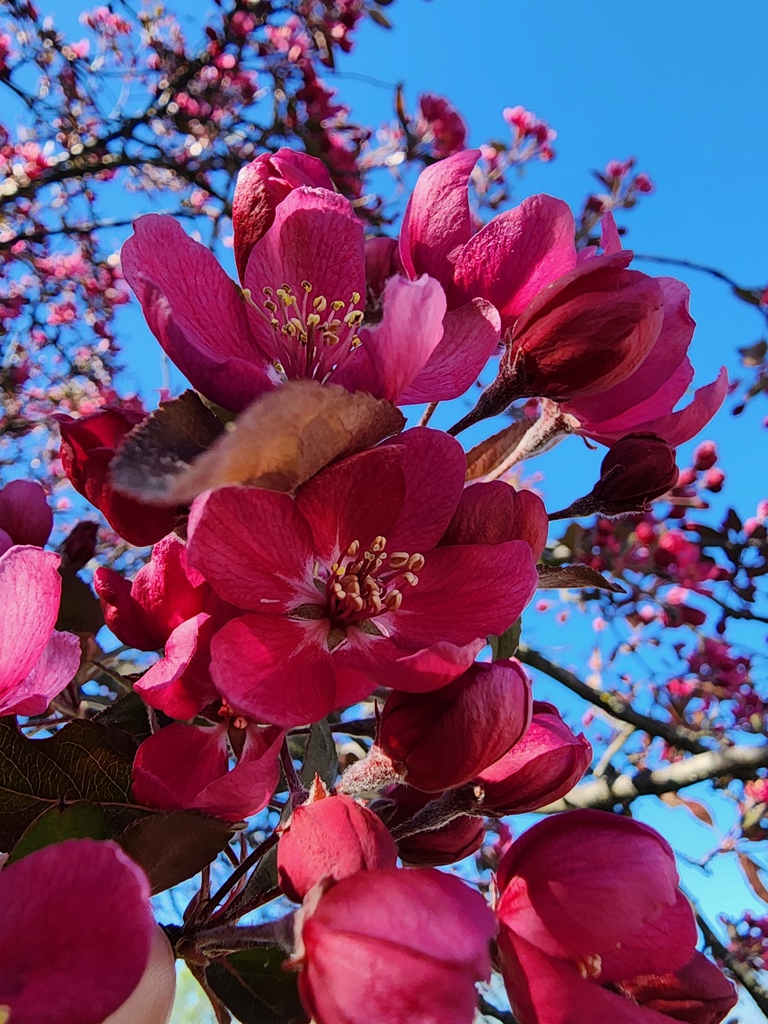
Spring has sprung in all of its’ flowering beauty. We’ve been blessed with many neighborhood strolls this season to savor the fresh scents of new life. This was a particular necessity this year as my job is largely performed at a desk and this pregnant momma was desperate to stretch her legs. The hubby was only too happy to join me.
The Catholic Church is chock full of traditions which point its members toward God and holy living. Many of these traditions have experienced the ebb and flow of popularity over time. However, rare though they may be, they remain with us as tools to supplement the teachings of the Church. There seems to be a common misunderstanding among practicing Catholics, laity and clergy alike, that because practices such as veiling for women, attending traditional latin mass, or kneeling to receive communion are so rare in society that they have somehow been deemed verboten or at the very least things to be frowned upon. In truth, there is nothing liturgically incorrect about any of these habits. The societal insistence on denying them can be incredibly damaging to the evangelization of our upcoming generations as young Catholics are currently the ones flocking back to these more traditional methods of worship. Thus, today I would like to set the record straight about all three.
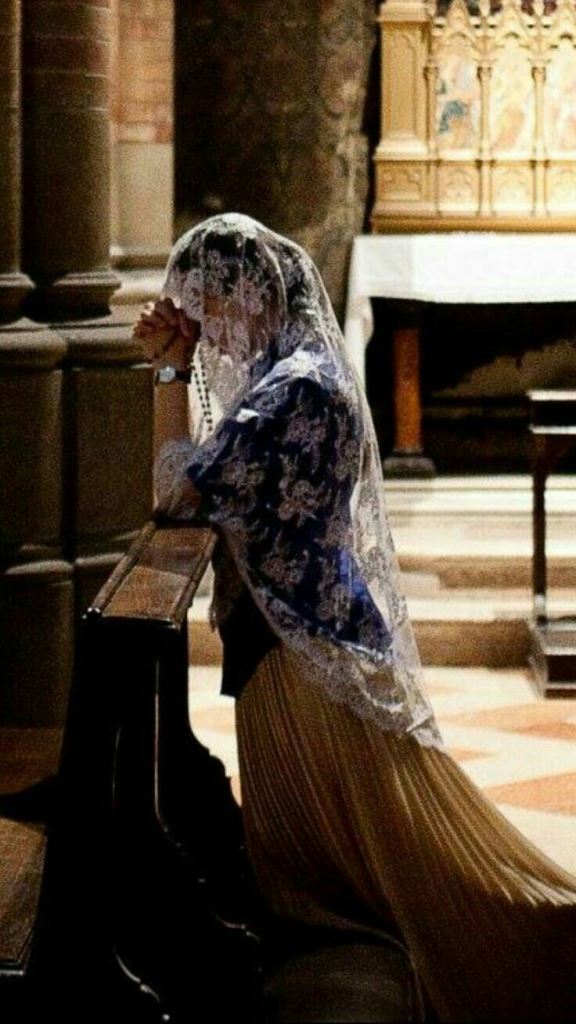
Veiling – I’ve received my share of funny looks when attending mass on account of my veil though, thankfully that has been the extent of my negative experience there. However, I know some of the ladies in my life have not been so lucky. Their decision to veil before the blessed sacrament has been called “ostentatious” by officials of the Church or else they were interrogated in somewhat less than civil tones over their reasons for veiling. Many priests today seem unable to fathom why any woman would choose to cover her head when approaching Christ in the sacraments.
The chief reason can be found in the question itself. As Catholics we believe that Christ is truly present in the sacraments, whether that be in the real body and blood of the Eucharist or as the person of Christ present as a priest administers confession. Our veils are not a means of showing off in church by flaunting our superior holiness as some seem to think. Rather, veiling is traditionally a practice which directs attention away from the beautiful women in the pews and instead puts the emphasis on Christ. Much like bowing before the altar, it is also a sign of deference to our Lord as well as a beautiful imitation of the Blessed Virgin Mary. I’ve discussed these and more reasons to veil in my post Why I Veil in Church but suffice to say that it’s hardly ostentatious for a woman to make this choice. It can more accurately be described as a feminine devotion to modesty.
Traditional Latin Mass – I first started attending latin mass before it became a common subject of debate among Catholic circles. I knew almost nothing about this kind of mass except that, in my experience, it had been incredibly beautiful, a reverent and genuine reenactment of Christ’s sacrifice. As I recently wrote about in Love Letter to the Latin Mass, every minute detail of this mass was gorgeously and thoughtfully orchestrated to point to our Lord. Once back at my home parish I briefly mentioned my experience to a few of my church friends. The response was a curt “that’s nice” before all three of them quite literally walked away from me. I was nonplussed. Still a baby Catholic and very recently converted at the time I couldn’t understand how something so beautiful could be deemed so taboo that it couldn’t even be discussed in narthex small talk. Novos ordo masses are of course perfectly valid and are often reverent and beautiful in their own right and I look forward to any opportunity to receive Christ. However, it was the beauty of traditions like the latin mass which ultimately ignited my faith.
Kneeling to receive on the Tongue – This practice has been the subject of controversy for two reasons. First, we are a society of efficiency and no one wants to hold up a line which is precisely how many view the decision to kneel. It’s true that kneeling does require a few extra seconds but this is one line which we ought never to rush. Receiving the true body of Christ in the Eucharist is not a chore. It’s not a box to be checked before heading off to the next errand. It is a necessity for the eternal salvation of our souls and one of the greatest blessings He ever gave us. To kneel is to show deference to His sacrifice which comes with the added bonus of being a much easier position from which to receive on the tongue. This brings us to the second objection many people have to this practice.
Particularly in our post COVID world, people are on high alert for germs. I’ve received some irritated frowns from extraordinary ministers and have even been scolded to “stick my tongue out farther” by a priest or two. In all honesty, there is no reason that the minister’s fingers need ever come into contact with anyone’s tongue though slip ups can occur. The fact is, this is the proper way that we Catholics should receive the Eucharist. Just as extraordinary ministers are to distribute communion in extraordinary circumstances (speeding up a long communion line is hardly extraordinary though has become commonplace), so should the practice of receiving on the hand be utilized. Receiving on the tongue is a safeguard for our own souls and for the preservation of the sacred Eucharist.
Traditionally, the priest was the sole distributor of communion for a very specific reason. His hands have been consecrated. His hands alone are clean and worthy to carry Christ during mass. Even the deacon’s hands have not been similarly blessed, much less those of the general laity. How could we possibly presume to hold God in our hands? By receiving on the tongue we avoid this dilemma. We also better ensure that each host is fully consumed then and there and not subjected to any further desecration or nefarious purpose, intentional or otherwise, when the assembly returns to the pews.
It’s little wonder that the Church is currently struggling to maintain young parishioners when proper practice and time-honored traditions are scoffed at. We believe that Christ is truly present in the sacraments, but we often fail to live as if that were true. Christ is our Lord, our God, our King. It’s high time we acted like it.
Yesterday Catholics everywhere celebrated yet another holy day on the liturgical calendar, the Feast of the Ascension. After suffering death on the cross and rising again on the third day Christ returned to His disciples for a time and continued His teaching. Yesterday marked the end of that teaching when he ascended into heaven.
With the due date for our baby girl fast approaching everyone wants to know how I’m feeling. All the mommies in my life are excited to commiserate on all the aches and pains of third trimester pregnancy, the itchy stretch marks, the ill fitting clothes, the inability to sleep comfortably and of course the sad realization of one’s newly increased girth. I know countless women have faced these and many more discomforts during pregnancy and I don’t diminish them in the slightest. However, on the whole, I’ve been blessed with a very easy pregnancy. There were a couple of sleepless nights and I certainly haven’t been immune to feeling a bit bloated on occasion but in general I’ve felt remarkably well throughout this experience.
After a necessary closet reset I’ve found that I’m still perfectly able to move, get outdoors and do most of the things I enjoy. Evening strolls around the neighborhood are a welcome means of clearing my head, breathing in some fresh air and getting the blood flowing. I’ve also been able to savor all of my favorite foods, maintaining healthy eating habits, with only slight adjustments to frequency and portion sizes. I have thankfully not been afflicted with unexpected and nauseating aversions to anything in particular. When people ask me how I’m feeling I can honestly say that I feel great!
I am totally overjoyed to be pregnant. Even the occasional jolt from a baby kick to the bladder makes me smile. She is constantly on the move, wiggling into more comfortable positions in my belly. She’s especially active when we go to mass or whenever we pray our daily rosary, as if she already knows that those prayers are for her. Those tiny kicks and flutters are welcome reminders of the beautiful life beginning inside me. We’ve also found that she responds to the sound of daddy’s voice and my husband has already begun the practice of bedtime stories for the little one.
We are both over the moon to soon be able to meet this baby girl. I can’t wait to hold my daughter, to soothe her with lullabies and cowboy songs as my parents did for me, to rock her to sleep at night and love her in every way a mother possibly can. Even the dirty diapers and traumatic bath times seem a welcome gift as I think about what the next years of our lives will bring. I truly can’t wait for every messy and exhausting detail of motherhood. It certainly will not always be easy or pleasant but there isn’t the faintest doubt in my mind that this is the very best thing I will ever do.
During this beautiful, blooming month of May, we celebrate the Blessed Virgin Mary in all of her motherly glory. I’m excited to draw closer to her this month especially as I approach the blessing of motherhood myself.










 Blessed in the Midwest