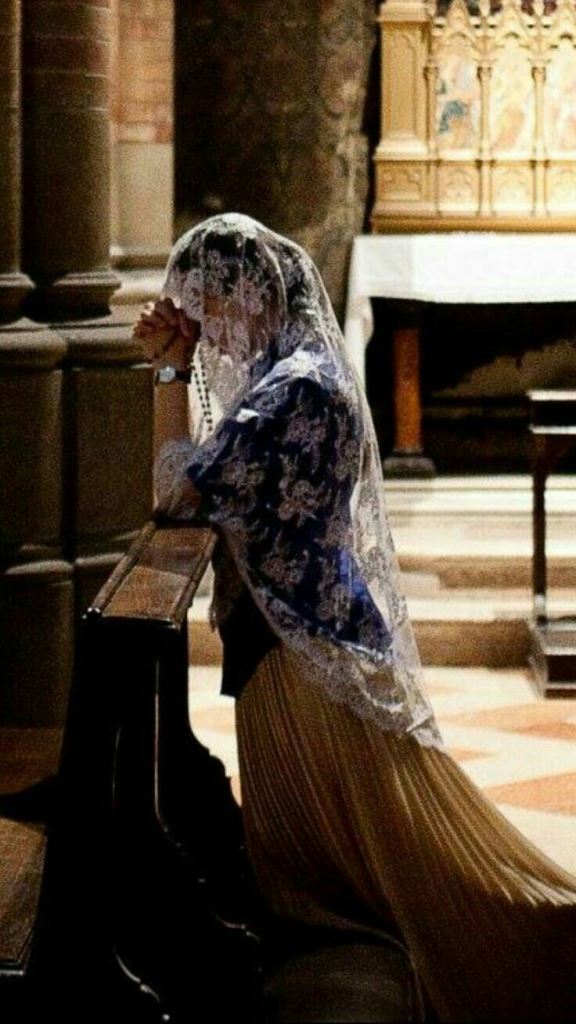
The Catholic Church is chock full of traditions which point its members toward God and holy living. Many of these traditions have experienced the ebb and flow of popularity over time. However, rare though they may be, they remain with us as tools to supplement the teachings of the Church. There seems to be a common misunderstanding among practicing Catholics, laity and clergy alike, that because practices such as veiling for women, attending traditional latin mass, or kneeling to receive communion are so rare in society that they have somehow been deemed verboten or at the very least things to be frowned upon. In truth, there is nothing liturgically incorrect about any of these habits. The societal insistence on denying them can be incredibly damaging to the evangelization of our upcoming generations as young Catholics are currently the ones flocking back to these more traditional methods of worship. Thus, today I would like to set the record straight about all three.
Veiling – I’ve received my share of funny looks when attending mass on account of my veil though, thankfully that has been the extent of my negative experience there. However, I know some of the ladies in my life have not been so lucky. Their decision to veil before the blessed sacrament has been called “ostentatious” by officials of the Church or else they were interrogated in somewhat less than civil tones over their reasons for veiling. Many priests today seem unable to fathom why any woman would choose to cover her head when approaching Christ in the sacraments.
The chief reason can be found in the question itself. As Catholics we believe that Christ is truly present in the sacraments, whether that be in the real body and blood of the Eucharist or as the person of Christ present as a priest administers confession. Our veils are not a means of showing off in church by flaunting our superior holiness as some seem to think. Rather, veiling is traditionally a practice which directs attention away from the beautiful women in the pews and instead puts the emphasis on Christ. Much like bowing before the altar, it is also a sign of deference to our Lord as well as a beautiful imitation of the Blessed Virgin Mary. I’ve discussed these and more reasons to veil in my post Why I Veil in Church but suffice to say that it’s hardly ostentatious for a woman to make this choice. It can more accurately be described as a feminine devotion to modesty.
Traditional Latin Mass – I first started attending latin mass before it became a common subject of debate among Catholic circles. I knew almost nothing about this kind of mass except that, in my experience, it had been incredibly beautiful, a reverent and genuine reenactment of Christ’s sacrifice. As I recently wrote about in Love Letter to the Latin Mass, every minute detail of this mass was gorgeously and thoughtfully orchestrated to point to our Lord. Once back at my home parish I briefly mentioned my experience to a few of my church friends. The response was a curt “that’s nice” before all three of them quite literally walked away from me. I was nonplussed. Still a baby Catholic and very recently converted at the time I couldn’t understand how something so beautiful could be deemed so taboo that it couldn’t even be discussed in narthex small talk. Novos ordo masses are of course perfectly valid and are often reverent and beautiful in their own right and I look forward to any opportunity to receive Christ. However, it was the beauty of traditions like the latin mass which ultimately ignited my faith.
Kneeling to receive on the Tongue – This practice has been the subject of controversy for two reasons. First, we are a society of efficiency and no one wants to hold up a line which is precisely how many view the decision to kneel. It’s true that kneeling does require a few extra seconds but this is one line which we ought never to rush. Receiving the true body of Christ in the Eucharist is not a chore. It’s not a box to be checked before heading off to the next errand. It is a necessity for the eternal salvation of our souls and one of the greatest blessings He ever gave us. To kneel is to show deference to His sacrifice which comes with the added bonus of being a much easier position from which to receive on the tongue. This brings us to the second objection many people have to this practice.
Particularly in our post COVID world, people are on high alert for germs. I’ve received some irritated frowns from extraordinary ministers and have even been scolded to “stick my tongue out farther” by a priest or two. In all honesty, there is no reason that the minister’s fingers need ever come into contact with anyone’s tongue though slip ups can occur. The fact is, this is the proper way that we Catholics should receive the Eucharist. Just as extraordinary ministers are to distribute communion in extraordinary circumstances (speeding up a long communion line is hardly extraordinary though has become commonplace), so should the practice of receiving on the hand be utilized. Receiving on the tongue is a safeguard for our own souls and for the preservation of the sacred Eucharist.
Traditionally, the priest was the sole distributor of communion for a very specific reason. His hands have been consecrated. His hands alone are clean and worthy to carry Christ during mass. Even the deacon’s hands have not been similarly blessed, much less those of the general laity. How could we possibly presume to hold God in our hands? By receiving on the tongue we avoid this dilemma. We also better ensure that each host is fully consumed then and there and not subjected to any further desecration or nefarious purpose, intentional or otherwise, when the assembly returns to the pews.
It’s little wonder that the Church is currently struggling to maintain young parishioners when proper practice and time-honored traditions are scoffed at. We believe that Christ is truly present in the sacraments, but we often fail to live as if that were true. Christ is our Lord, our God, our King. It’s high time we acted like it.

 Blessed in the Midwest