How Do You Know?

Photo by Rainstorm Photo

I was once asked in a discussion about marriage how I knew my husband was the one. By modern standards our courtship was the brief, whirlwind kind. After knowing me for only four months he asked my parents for their blessing to marry me. It took another two months for the ring to come in and he got down on one knee as soon as it did. Our official engagement lasted a short six months and we were wed almost exactly one year to the day that we met in person for the first time. To rational people, this timeline might seem crazy or, at the very least, a bit rushed. How can you possibly know after four months that this is the person you want to spend the rest of your life with? However, I can truly say that it was the easiest decision I’ve ever made. 

I’ve written on this subject before in Dating to Courtship: Romance with Intention but I think the secret to our seemingly fairytale romance is that we never actually dated. From day one, we were vetting each other for marriage. The goal of our relationship was never simply to have fun though that was a huge bonus to our courtship. Pleasure and happiness were never the main objectives for either of us. Since that very first date to Pentecost mass it was obvious that this man wanted my soul to go to heaven and would actively work toward that end. There hasn’t been a second since that day that I doubted this key fact. 

After this realization, “boyfriend” always felt much too inadequate a title. I never grew accustomed to it because, in truth, he could only really be described as a besotted suitor. It was a relief to graduate to the term “fiance.” On our third date we were discussing our marriage goals and not long after that I casually mentioned the story of my brother-in-law asking for my parents’ blessing to marry my sister. Call me old fashioned but it’s a tradition I value and the hubby took the hint at the time. The second time he ever met my parents he bravely initiated the “I’d love to marry your daughter” chat. They’d had a little heads up from me that this might be coming and were only too happy to grant their blessing. The hubby surprised me with ring shopping not long after. 

Over the course of our three years together (two as man and wife) he’s never ceased to woo and spoil me and he’s never tired of what I know he considers his sacred duty to see my soul enter the kingdom of heaven. Each and every step of our journey together has been guided by that holy purpose. It was a very simple roadmap to follow and we both were totally dedicated to it. That’s not to say that we’ve been perfect people throughout the entirety of our relationship. Feelings and passions ran extremely high during our courtship, engagement and even still today in our marriage but we helped each other in those moments. We were and are helplessly, head over heels, weak at the knees, madly in love with each other but we checked each other when needed, taking great care never to get too carried away during those early months.

This was a kind of devotion I didn’t know existed before I met him. After encountering it, I knew that no one else would ever do. I could have spent the rest of my life searching for another man who would love me that much, right down to my very soul. Thus, I didn’t just want to marry this man. I had to or else resign myself to the reality that no one else would ever care for me so well. I still wonder sometimes how I could possibly deserve him but perhaps that’s the point. God didn’t send me this wonderful man because I deserve him. Perhaps He did it because I’ll spend the rest of my life doing whatever it takes to be a worthy partner. A life spent following and serving a godly man in the holy sacrament of matrimony is itself a godly life.

Getting Back to Traditions

Photo by Godly Woman

The Catholic Church is chock full of traditions which point its members toward God and holy living. Many of these traditions have experienced the ebb and flow of popularity over time. However, rare though they may be, they remain with us as tools to supplement the teachings of the Church. There seems to be a common misunderstanding among practicing Catholics, laity and clergy alike, that because practices such as veiling for women, attending traditional latin mass, or kneeling to receive communion are so rare in society that they have somehow been deemed verboten or at the very least things to be frowned upon. In truth, there is nothing liturgically incorrect about any of these habits. The societal insistence on denying them can be incredibly damaging to the evangelization of our upcoming generations as young Catholics are currently the ones flocking back to these more traditional methods of worship. Thus, today I would like to set the record straight about all three. 

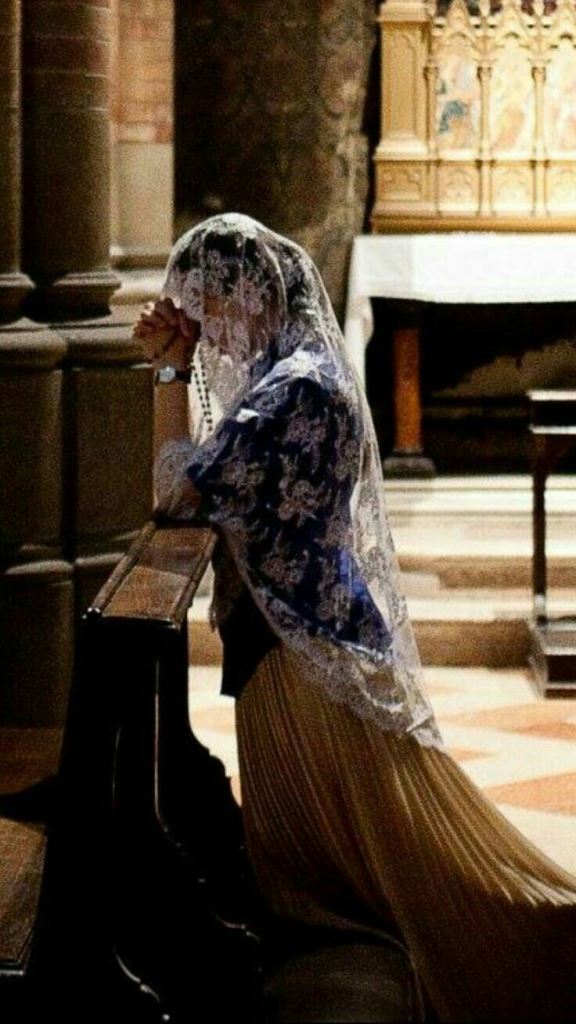
Veiling – I’ve received my share of funny looks when attending mass on account of my veil though, thankfully that has been the extent of my negative experience there. However, I know some of the ladies in my life have not been so lucky. Their decision to veil before the blessed sacrament has been called “ostentatious” by officials of the Church or else they were interrogated in somewhat less than civil tones over their reasons for veiling. Many priests today seem unable to fathom why any woman would choose to cover her head when approaching Christ in the sacraments.

The chief reason can be found in the question itself. As Catholics we believe that Christ is truly present in the sacraments, whether that be in the real body and blood of the Eucharist or as the person of Christ present as a priest administers confession. Our veils are not a means of showing off in church by flaunting our superior holiness as some seem to think. Rather, veiling is traditionally a practice which directs attention away from the beautiful women in the pews and instead puts the emphasis on Christ. Much like bowing before the altar, it is also a sign of deference to our Lord as well as a beautiful imitation of the Blessed Virgin Mary. I’ve discussed these and more reasons to veil in my post Why I Veil in Church but suffice to say that it’s hardly ostentatious for a woman to make this choice. It can more accurately be described as a feminine devotion to modesty. 

Traditional Latin Mass – I first started attending latin mass before it became a common subject of debate among Catholic circles. I knew almost nothing about this kind of mass except that, in my experience, it had been incredibly beautiful, a reverent and genuine reenactment of Christ’s sacrifice. As I recently wrote about in Love Letter to the Latin Mass, every minute detail of this mass was gorgeously and thoughtfully orchestrated to point to our Lord. Once back at my home parish I briefly mentioned my experience to a few of my church friends. The response was a curt “that’s nice” before all three of them quite literally walked away from me. I was nonplussed. Still a baby Catholic and very recently converted at the time I couldn’t understand how something so beautiful could be deemed so taboo that it couldn’t even be discussed in narthex small talk. Novos ordo masses are of course perfectly valid and are often reverent and beautiful in their own right and I look forward to any opportunity to receive Christ. However, it was the beauty of traditions like the latin mass which ultimately ignited my faith. 

Kneeling to receive on the Tongue – This practice has been the subject of controversy for two reasons. First, we are a society of efficiency and no one wants to hold up a line which is precisely how many view the decision to kneel. It’s true that kneeling does require a few extra seconds but this is one line which we ought never to rush. Receiving the true body of Christ in the Eucharist is not a chore. It’s not a box to be checked before heading off to the next errand. It is a necessity for the eternal salvation of our souls and one of the greatest blessings He ever gave us. To kneel is to show deference to His sacrifice which comes with the added bonus of being a much easier position from which to receive on the tongue. This brings us to the second objection many people have to this practice.

Particularly in our post COVID world, people are on high alert for germs. I’ve received some irritated frowns from extraordinary ministers and have even been scolded to “stick my tongue out farther” by a priest or two. In all honesty, there is no reason that the minister’s fingers need ever come into contact with anyone’s tongue though slip ups can occur. The fact is, this is the proper way that we Catholics should receive the Eucharist. Just as extraordinary ministers are to distribute communion in extraordinary circumstances (speeding up a long communion line is hardly extraordinary though has become commonplace), so should the practice of receiving on the hand be utilized. Receiving on the tongue is a safeguard for our own souls and for the preservation of the sacred Eucharist. 

Traditionally, the priest was the sole distributor of communion for a very specific reason. His hands have been consecrated. His hands alone are clean and worthy to carry Christ during mass. Even the deacon’s hands have not been similarly blessed, much less those of the general laity. How could we possibly presume to hold God in our hands? By receiving on the tongue we avoid this dilemma. We also better ensure that each host is fully consumed then and there and not subjected to any further desecration or nefarious purpose, intentional or otherwise, when the assembly returns to the pews.  

It’s little wonder that the Church is currently struggling to maintain young parishioners when proper practice and time-honored traditions are scoffed at. We believe that Christ is truly present in the sacraments, but we often fail to live as if that were true. Christ is our Lord, our God, our King. It’s high time we acted like it.

From the Mountain Top

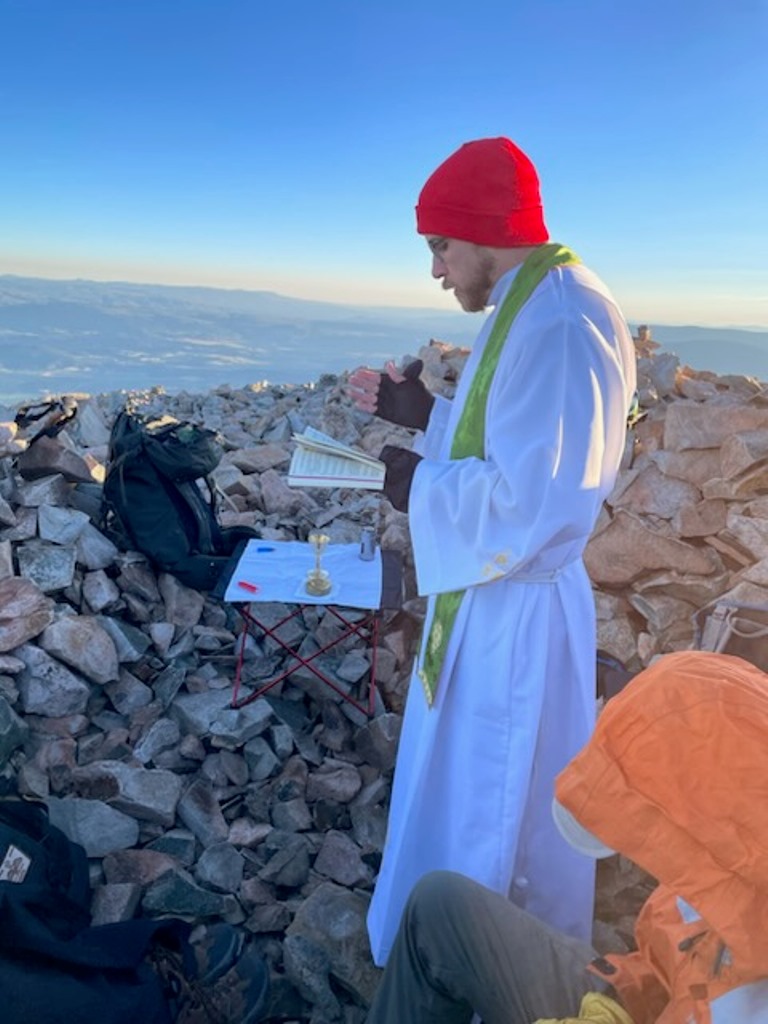
I’ve previously mentioned on this blog, my desire to celebrate mass in the mountains with my parents and our family priest friend. God hears and answers all prayers in His own way and His own time. During a Colorado trip this summer we were finally able to go hiking with the Father. For many reasons, this experience was a beautiful and singular gift from God. Many of our mountain adventures take us to remote lakes in the clouds with stunning views along the way but on this occasion we chose a special destination. Mount Sopris proudly stands at the head of our little valley, a picturesque set of twin peaks which is in view from almost anywhere in my hometown. While this isn’t the tallest mountain in the area it is certainly among the more formidable hikes around. It is a 14 mile trek round trip over a variety of rugged terrain. 

Growing up and before any of my family were even entertaining ideas of coming to the faith, Mount Sopris stood as a perpetual reminder of the beauty of creation whenever we happened to glance up the valley. As my sister and I grew older it also became a testament to our determination, our own personal Everest, as we both reached the summit for the first time when I was just 10 years old. At the time, it was possibly the hardest thing I’d ever done and my skinny legs were shaking when we arrived back at the truck that day. However, I never regretted having done it. On the contrary, after wiping away a few tears as well as plenty of dirt and sweat, I felt like I was still standing on top of the world, realizing for the first time that I can do hard things. 

Since that initial trip up Sopris as kids, my family has completed this hike several times, though the last instance was when I was in high school. As such, we thought it a fitting experience to share with my husband and our priest friend, both relatively new to Glenwood Springs and never having done this hike before. Our first small blessing came with the priest’s ability to clear his schedule for the occasion. This is hardly a short afternoon jaunt into the wilderness. Thankfully, the day was wide open for our adventure. We began our journey in relative darkness, setting out from the trailhead at 2am to avoid the long upward slog in the midday sun and to reach the top by sunrise. While the rest of the world slept soundly in the valley below, we hiked to the light of a super blue moon on a cloudless summer night. This was the second blessing. The small pools of light from our headlamps were almost unnecessary at times and paled in comparison to the shining silver orb floating in the sky above us. 

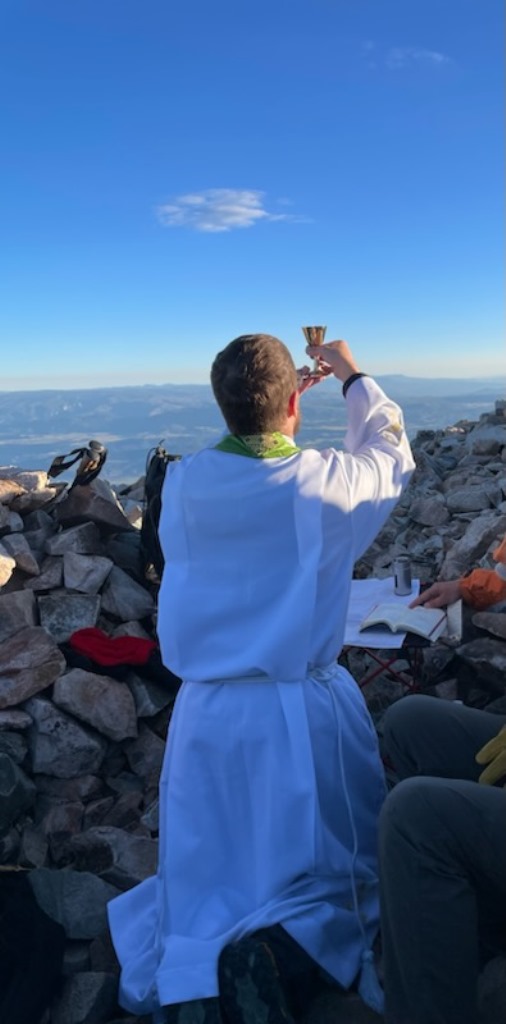
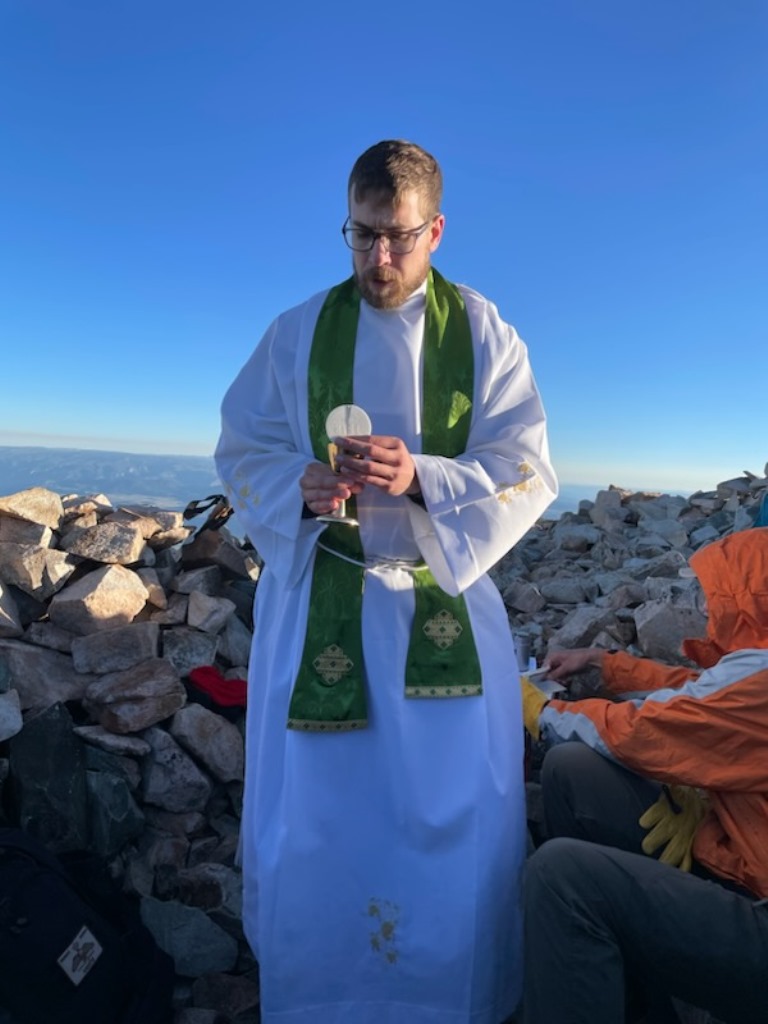
My husband and the priest both reached the summit just as the Sun sliced through the dregs of evening while my parents and I arrived a short ten minutes later. There is no comparable feeling to standing on top of the world when the Sun comes up, watching it bathe everything in honey light. Its warmth was slow to reach us as we stood on the summit but we’d packed for the occasion and quickly donned thick fleece jackets and pulled knit hats over our ears. Once everyone had caught their breath, the men set to work preparing a makeshift altar and the Father pulled a chasuble from his pack. 

Before my conversion to the faith I often wondered why anyone would need church when we have nature. What better way could there be to worship than to simply witness the wonders of God’s creation. I’ve since come to realize the errors in my thinking, now with a much more complete understanding of the happenings in a Catholic mass and Catholic sacraments. To participate in the sacrifice of the mass is always a miraculous blessing but this reverent ceremony on the peak of Mount Sopris, a beloved monument of my childhood, in which the priest consecrated the entire valley below us was a gift I will never forget. The first time I ever stood on this mountain I’d been a child. Now, I returned as a baby Catholic, a child in God’s eyes.

Starved for Holiness, Not Pop Culture

Photo by David Dibert

In every parish I visit there seems to be a huge emphasis on attracting new young Catholics to the faith. It’s no surprise. They are the future of the church and are desperately needed. However, nearly every appeal to these young people that I’ve witnessed has been a play on modern pop culture and precisely the opposite of what drew me to the faith as a 21 year old fresh out of college.

It wasn’t the rocking drums and electric bass from our parish Life Teen band that I found so enticing. Although those musicians are certainly talented and their music is something that I still enjoy in the car on my way to work, it is at odds with the quiet, reverent beauty to be found inside a Catholic church. I wasn’t starved for pop culture. I was desperate for holiness, peace and Christ in my life, even before I consciously accepted that fact. 

The moments which ignited my faith were all moments of quiet reflection. The first of these came during an advent vespers service led by our former associate priest. It was an eye-opening experience which I will never forget. The sanctuary was completely dark except for the altar which was ablaze with the warm flickering glow of dozens of candles. The entire service was conducted in a reverent silence broken only by the sweet tenor of the associate priest as he guided the assembly in musical hymns at the beginning of the service.After group prayer was finished there was a time of silent prayer for parishioners to light candles in front of the altar for their own prayer intentions. 

In that darkened, quiet sanctuary I finally felt the presence of God. I consciously accepted Catholic teachings very early in my faith journey but it took a bit longer for my heart to catch up. I understood these teachings to be true months before emotionally investing in them. This advent vespers service was the first time that I truly felt the presence of the Holy Spirit. 

Everyone is so quick to fill the silence these days. There seems to be a persistent assumption that we can’t possibly focus in absolute quiet and that we must fill every waking moment with noise, in particular, the hip guitar music that all those young folks are so fond of but if we are constantly surrounded by all of this noise and activity, how then will we hear the voice of God when he speaks to us? We need peace in our lives, the kind of peace that only silent and sincere prayer can bring. We grow up learning how to clap in time to our favorite tunes. What we need now is to learn to stop and listen. Church isn’t where we come to be moved by the music. It’s where we come to be moved by Christ.