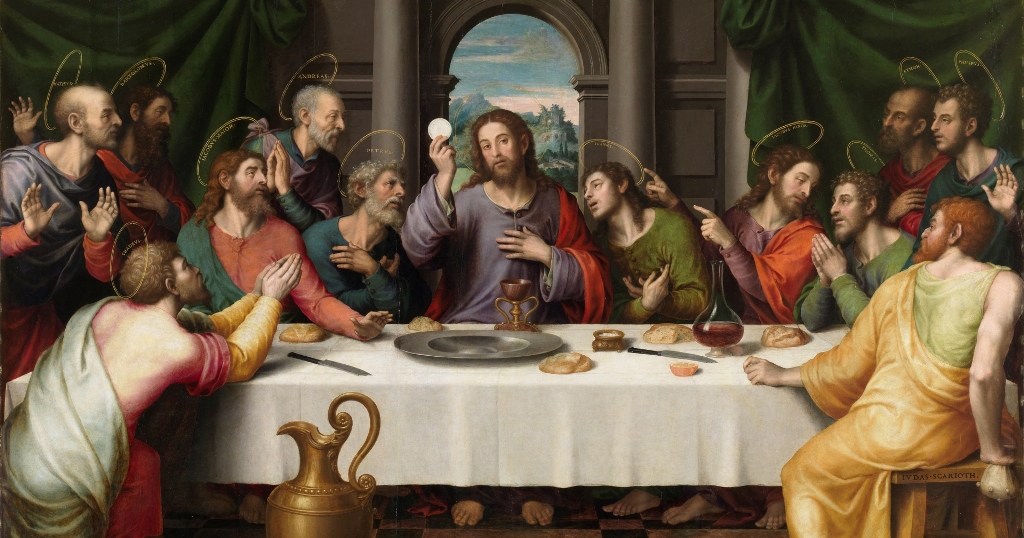
The Last Supper and The Washing of Feet

Image from: Ascension Presents

I don’t normally post on Thursdays but this is Holy Thursday and I was blessed with a special experience this year regarding this day on the liturgical calendar which caused me to dig deeper into the Catholic faith. I was asked to participate in the Washing of Feet. Many people are aware of this beautiful tradition in the Catholic Church in which the priest washes the feet of twelve parishioners in memory of the Last Supper as Christ washed the feet of the twelve disciples. It is an incredibly humbling display of service and discipleship for both the priest and those having their feet washed and I was honored to be asked.

However, even as I agreed to participate, I felt a nagging hesitation in the back of my mind as I struggled to recall something my mom had once told me about the foot washing and how it was traditionally reserved for men. Back at home I called her to learn more about this Catholic tradition in which I was soon to take part. She was more than happy to speak on the subject and sent me a few resources to dig further into the practice, having done quite a bit of research herself. 

I discovered that this tradition is indeed about service and discipleship, but a particular kind of service, that of the priest and the institution of Holy Orders. Without Holy Orders, we would not have priests. We need priests to confer the sacraments, especially Reconciliation and the Eucharist. Indeed, without holy men to enter into the priesthood, we would not have a church. Instituting the priesthood on Holy Thursday, I learned, began the lineage of apostolic succession, from those men gathered at the Last Supper right down to the priests in our very own parish! What a gift!

This is a kind of service which I as a woman will never be able to perform. I don’t feel at all disrespected or excluded to acknowledge this. On the contrary, I love that the Catholic Church celebrates the complementary nature of men and women for it is through our differences that we best serve God. For myself, I can think of no better way to profess my love for Christ than through service in holy marriage and it brings me no end of relief that I have been called to such a marriage. My Catholic wifely duties don’t make me any less worthy to receive God’s saving grace than those holy men who enter into the priesthood. I simply am called to a different kind of service. 

Although the foot washing has been made available to men and women by our Holy Father, Pope Francis, I realized that I am not the ideal candidate for this Holy Thursday tradition and ultimately declined the invitation although I will be blessed to be present to see my husband participate. I was truly honored to be asked to take part in the foot washing as it gave me an opportunity to dive deeper into the faith and the history behind this tradition in our beautiful Catholic Church. However, knowing what I know now, I am also equally happy in my decision to be an observer rather than a participant.

Thank you to all the holy men who have chosen the priesthood for all that you do.

Lady Boss or Super Mom?

Photo by Taryn Elliott

This is the question facing modern women. I know many people on both sides who say it’s hardly a question at all and that the answer is obvious. I know how I’d answer it. Our society likes to tell women that their greatest worth will come from high powered careers, that they can have families if they want to but that they should have careers. Frankly, I have to agree with Jordan Peterson’s perspective on this one. Only a very select few ever actually achieve careers. The rest of us go to jobs everyday. Some jobs are undoubtedly more enjoyable than others but they’re all generally performed for the same purpose of paying the bills and not work that someone would do for free. 

There are the dreamers of the world, those high flying individuals who become masters and leaders in their fields and of course there are women among them. However, to treat those women as the rule rather than the exception is to dismiss the ultimate feminine superpower, the ability to give birth. We alone have the capacity and natural inclination for motherhood. Some people say that a woman’s worth should be measured by more than her ability to push out babies and they’re absolutely right. Being an effective mother is about raising those babies to be good, virtuous people.

Success and ambition are incredibly enticing. I myself can attest to that. It feels good to be financially independent, to stand on your own two feet, to not worry about how to pay your bills and to be able to afford the things you enjoy. The deal is only sweetened as a career trajectory does begin to take shape. A technical degree in a STEM field paired with a job in a fairly stable industry that’s currently hemorrhaging retirees has upward mobility written all over it. It’s not difficult to imagine a future.

But all the money and success in the world doesn’t hold a torch to how badly I want to be a good wife and mother. There are certainly women out there who learn to split the difference and excel in motherhood and their careers but even in this there are sacrifices. Even the most well organized and motivated people have their limits. There’s only so much of you to go around. Choosing how to spend it is a necessary evil of our empowered and fast-paced world.

Financial independence can be a huge step toward maturity and adulthood as it was for me. It was a key motivator but it was never the goal, nor do I think it should be. I don’t think anyone should ever become so proud of their workplace accomplishments that they forget who and what they’re working for. There’s nothing wrong with being an empowered lady boss. Whatever you do should be done with excellence but people are often quick to forget that concept extends to the home as well.

Properly Oriented

Today I find myself recalling a homily from one of our priest friends on Ash Wednesday. He touched on the three main tenets of Lent; prayer, fasting and almsgiving but he went further to instruct on how these should orient our lives beyond Lent. After all, God created us for labor, love and leisure. I think that first one gets forgotten sometimes or at least pushed a little lower on the priority list. God clearly does not want us to neglect ourselves but love and leisure are often byproducts of labor. 

This was the point that our friend was making when he spoke to the assembly. We are happiest and most fulfilled when we are working for the service of others. Money and success can better enable us to help our neighbors but they themselves cannot be the goal. It’s easy to fall into the habit of defining new challenges in life by what we can get out of them. I’m certainly guilty of this. But this thinking is precisely backwards. 

We should not be the center of our own lives. The Sun around which our worlds must revolve is the Son of God. We can only ensure this proper orientation toward Christ through genuine service. Only when we give ourselves to other people can we experience the bliss of doing God’s work. 

The Feast Day of Saint Patrick

Although not originally native to Ireland, Saint Patrick’s work there spanned nearly all his life. He was born in Roman Britain but was captured by Irish pirates when he was young and was sent to Ireland to work as a slave. He never lost his faith and years later he escaped and returned to Britain. Despite his former captivity, Saint Patrick felt called back to Ireland to bring the Gospel to the pagan country. Thus he set out to become a priest and later a bishop before traveling to Ireland a second time. Saint Patrick is still celebrated and Ireland, nicknamed the Isle of Saints and Scholars, was home to many more saints throughout history thanks to his work.

It’s Hard to be Catholic

Photo by Pixabay

I came home grumpy the other day and despite knowing that most of my frustration was largely out of my control, I immediately began complaining to my husband when I walked in the door. It had been a less than stellar day in the office. The friends and family that I’d tried calling on the drive home had all been busy and although I had no major update to give them, I missed them very much. I’ve also been consumed lately with thoughts of the future and trying to figure out how my husband and I might go about starting a family amid two full time careers. 

I know that God will provide for us so long as we continue to turn to Him in our struggles. I’m also well aware that these are small change compared to the trials of others. I understand that prayer is often the best medicine and we need only bear our crosses and give them up to God. However, as I sat next to my husband while we prayed our daily rosary I was struck by how un-catholic my behavior had been that day. I had not done any of the prayerful things I just mentioned. This was also in dramatic contrast with my husband’s actions as he spent the entire evening going out of his way to cheer me up. 

Being catholic is not always easy. It’s far easier to whine and gripe about every little thing that’s going wrong. In the moment, God can slip our minds entirely as was my case. It didn’t even occur to me that day to relinquish my frustrations to Him. But while we keep faith in God, we are never alone and it’s times like these that I feel unbelievably blessed that He sent my husband to me to be an example and a friend on the bad days. As members of God’s universal church we have the privilege of seeing Christ everyday if we keep our eyes open, whether it be in the kindness of a random stranger on the street, in the devout worship of our fellow parishioners during Sunday mass, or in the love and care we receive from spouses, family and friends. 

My Adult Conversion: Beauty of Catholic Marriage

Photo by Rainstorm Photo

I first started attending mass at a time in my life when I felt that modern society had utterly failed me. By all accounts, I had lived an extremely successful life up to that point, making all the widely accepted ‘responsible’ decisions and striking out on my own. I was a well educated, fiercely independent young woman embarking on a lucrative career in a STEM field. However, in addition to graduating with a fancy engineering degree and a job in the steel industry I also tasted real regret for the first time over decisions which society continued to assure me were perfectly smart and reasonable. 

We’re all only human, ignorant and error prone and I’m no exception. But having been raised by two intelligent and amazingly supportive parents, there were some lessons I was convinced I’d never have to learn the hard way. I thought I was smart enough not to make certain mistakes, particularly when it came to dating. I did everything right by cultural standards and had a good life but was still very far from the person I wanted to be. 

After months of genuine scrutiny of my core beliefs, I began to reorient my life in accordance with Catholic teachings although that was hardly my goal at the time. It was the beauty of the church’s stance on marriage which first struck my fancy. In a world of ‘good enough for now’ and ‘let’s see how it goes’ I was completely enamored by the idea that two people could love and trust each other enough to wait for each other and the sacramental bond of marriage. People are so impatient these days and chastity is such an unpopular virtue on a college campus. 

That isn’t to say that I didn’t have solid role models in my life when it came to marriage. My parents are two of the most in love people I’ve ever met. But finding that one person to spend the rest of your life with is a tricky business, especially when the dating pool is full of people who are convinced that marriage is just a piece of paper. I once heard a newly engaged coworker say “you wouldn’t buy a car without test driving it first,” referencing her relationship with her fiance. At the time I had no intelligent argument to offer except that people are not cars. They are not objects to be used and abused for your pleasure even if they’re willing to consent to such treatment on the grounds that it’s mutual. 

As previously stated, Catholic marriage is a sacrament, one in which you vow to each other and to God to die to yourself everyday for the good of your spouse. The ultimate goal is to ensure that your husband or wife enters the Kingdom of Heaven. The sexual embrace is a renewing of those vows and thus ought to be reserved only for marriage. Obviously you should be choosy when selecting your spouse and you both need to be generally compatible but you don’t have to sleep together to figure that out. There are many far more telling judges of a person’s character than their ability to please in the bedroom. Their ability to keep their hands to themself as they wait in anticipation for marriage is a perfect example. 

Having recently been married, I can happily attest that there is no greater feeling than knowing with absolute and total certainty that my husband and I are madly in love for all the right reasons. He doesn’t just attend to my everyday physical and emotional needs as a loving, doting husband. He cares about my soul. It was a very happy day in my life when I discovered that it’s possible to love and be loved that much.

How Did Christ Dying on the Cross Save Me?

Photo by Alem Sánchez

John 3:16 – For God so loved the world, he gave his only Son.

During my journey through Rite of Christian Initiation for Adults (RCIA) as I deepened my understanding and faith I slowly relinquished my skepticism and somewhat antagonistic questions. When I finally stopped trying to poke holes in the Catholic teachings I found that they resonated incredibly well with me. I started implementing all sorts of changes in my life, both big and small, in order to lead my best Catholic life. I was left with only a few major questions about the faith and these I approached with genuine curiosity and a strong desire to grow closer to God. 

One of the main tenets of the church is that Christ died on the cross for our sins. In my Catholic infancy I struggled to wrap my head around this. Even after accepting that Christ was both human and divine as the son of God, how could someone who lived so long ago be able to absolve me of my sins today? How could He have known my mistakes before I’d ever made them? 

I soon discovered that I already had part of the answer. It was the dual nature of Christ that enabled him to take on the sins of the world. He was fully human and fully divine, a true son of God and yet still subject to all the sufferings we experience here on Earth. There is a common misunderstanding among people today about the association between sin and humanity. Many people believe, as I did, that to be human is to sin. However, we are made in the image of God in both body and soul and true humanity is not sinful. God only creates good things and did not create us with original sin. This came later in the Garden of Eden with the fall of Adam and Eve. Our free will enables us to deliberately turn away from God but it is not our sin which makes us human. It is our suffering. Christ was fully human because he was without sin. He shared in all our earthly suffering but was always turning toward God. 

In dying on the cross he took upon himself the condition of our sinfulness. It was God’s love for humanity which led Him to sacrifice His Son for the collective sin of the world as a parent sacrifices for a child. The Holy Trinity, the Father, Son and Holy Spirit, are outside of time. This is where the divinity of Christ plays a part. As a member of the Holy Trinity, when Christ took the sins of the world upon himself, it was not the sins of the world in that instant but all sins throughout all of time. 

Many months later, I’m still trying to find ways to reverence Christ for this ultimate sacrifice. It’s easy to write off every mistake as a learning experience and continue through life with the belief that we’re all generally good people. While this may still be true, upon honest reflection, I can pinpoint moments in my life when I wish I’d made different choices and I know exactly what He died for.

Lent: What Are You Giving Back?

Everyone wants to know what you’re giving up for Lent but no one ever asks what you’re giving back for Lent. It’s not just a self-improvement kick to get a few of your preferred vices in check. What are you doing with all that extra time that you’re not wasting scrolling through social media? How are you leading your family to new healthy habits now that sweets are off the menu? Most importantly, how do your Lenten sacrifices give glory to God?

Lent is a penitential preparation for Easter and the resurrection of Christ. The forty days leading up to this christian holiday are intended to be a time of sacrifice in which we imitate the forty days of Christ’s fasting in the wilderness before he began his public ministry. As Catholics we do not fast when the bridegroom, Christ, is present in the church. This occurs in the holy Eucharist during Sunday mass and thus Sundays during Lent are a time of relaxed fasting although they should not be treated as cheat days or an excuse to over indulge. This would encourage us to look forward to Sunday for the wrong reasons. Fasting between meals can be suspended on these days but other Lent offerings should continue through the duration of the entire forty day season. 

Here are a few tips for diving into your Lenten resolutions this year.

  • Be intentional – Don’t wait until the last minute to set your Lenten goals. It’s even harder to keep yourself honest when you decide on your Lenten sacrifices after the fact.
  • Replace old habits with new ones – Don’t be content to simply remove bad habits from your schedule. You still need to find something else to fill those holes in your life so find prayerful and charitable activities that you can do instead. Find ways to center this forty day fast around Christ. 
  • Be specific – The wishy washy goals are always the hardest to achieve. Choose specific activities, foods or experiences that you will avoid this season and exchange them with equally specific habits that bring you closer to God.
  • Live Liturgically – In conjunction with other Lenten sacrifices we are called to abstain from meat on Fridays. This practice can also be continued beyond Lent as a weekly reminder of Christ’s sacrifice for us although it is no longer an official teaching of the Catholic Church. 
  • Write it down – If there’s no record of it, who’s to say that was actually your Lenten sacrifice in the first place? This will help you stay true to yourself and to God. 
  • Share the burden – Tell someone, a spouse, a parent, a friend, what your intentions are this Lent season and ask them to help you stick to those offerings. You don’t have to do it alone. 
  • Don’t budge – It’s not supposed to be easy. Every time you have a craving for your favorite indulgences is a reminder to stop and think about why you’ve made this sacrifice in the first place. It’s an opportunity to reflect on God’s sacrifice for us. When this happens don’t be afraid to send up a quick Hail Mary or Our Father asking for intercessions to help you stay true to your Lenten fast this season.

The Real Presence

I attended a theology uncorked event recently where the associate pastor gave a presentation on the Eucharist. His talk was full of calls to live our faith in small everyday ways and to embrace all doctrines of the Catholic church. This was truly more of a plea than a demand as he cited studies showing an overwhelming majority of Catholics do not believe in the real presence. How can this be?

Along my journey to faith terms like ‘benchwarmers’ and ‘piecemeal Catholics’ came up. There will always be those who struggle to practice what they preach or see fit to only follow certain teachings of the faith which they find most to their liking. But when did they become the rule instead of the exception? 

How can we help them? As a member of several ministries within our parish and as a newly devout Catholic myself I’ve been asking this question a lot lately. Sometimes I still struggle to find the balance between being pious and preachy and being a loving disciple of Christ. Of course everyone must accept Christ’s teachings in their own time and of their own free will. We can’t force people to believe in the real presence at mass. But as Catholics we are called to love our neighbors which includes spreading God’s word and love and speaking up when we see our brothers and sisters going wrong in their faith. 

Through transubstantiation, the consecrated host and wine at mass truly become the body and blood of Christ. As the associate pastor reminded us, we do not go to mass for the music or the aesthetic or even the homily. All of these things help us to worship and praise God but they are not the purpose of the Catholic mass. We attend church every Sunday to receive Christ through the Holy Eucharist. We become living hosts of God and subject to all the graces which come with that. 

Mass is not simply an empty routine to fill an hour every Sunday. Mass is where we go to worship God. Whether we enjoy the homily or are pleased with the choir’s performance, we always receive Christ.  

Giving It Up To God

We all go through slumps in life whether it be due to relationship difficulties, workplace frustration, or simply the occasional day-to-day monotony which can creep into our activities if we’re not careful. Everyone has a cross to bear in this life but in turning to God during our times of woe, our suffering is not in vain.

Just as God used the suffering of His only son on the cross to forgive our sins, He uses our own personal sufferings on Earth for good. It’s easy to look at our lives and bemoan all the things that aren’t going our way. I know I struggle to see the silver lining sometimes. I’m a verbal thinker and rarely hesitate to vent my frustrations to my husband or my mom as a means of processing it all. This can be a helpful practice but there is a fine line between venting and whining. 

As Catholics we are called to trust in God in all things even when we struggle to see a good outcome. Sometimes the very best thing we can do is offer all of our discomforts and frustrations to God. We are not all made for great glory or fame despite the fact that, on some level, I think most people daydream about changing the world. But what could be more glorious than being a good spouse, parent, friend, employee? What could be grander than doing your very best in the life that God gave you, bearing your lumps without complaint?

This is not a lesson that’s easy for me to embrace. As stated earlier, I’m quick to vent (complain) about my lumps. I was raised to be very solution oriented and upon encountering situations that I find distasteful, I’m equally as quick to start dreaming up ways to change my life in order to avoid similar future situations. This kind of thinking isn’t necessarily wrong but sometimes the true test of character is not to search for the nearest exit when discovering a problem.

Of course God wants us to be happy, successful and fulfilled in life. This is evidenced through the individual talents which he blesses us with. We are each called to give glory to God in our own ways and through our own gifts. But even in this there are trials and obstacles to overcome. Imagine all the good we might see in the world if we all offered it up to God a little more.